> For the complete documentation index, see [llms.txt](https://guia-de-uso.tiflux.com/llms.txt). Markdown versions of documentation pages are available by appending `.md` to page URLs; this page is available as [Markdown](https://guia-de-uso.tiflux.com/integracoes/projetos/integracao-jira/nao-foi-possivel-criar-a-issue-pelo-tiflux.md).

# Não foi possível criar a Issue pelo Tiflux

Ao tentar criar uma issue no Jira, a partir do Tiflux aparece a seguinte mensagem:
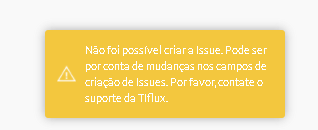
![](https://firebasestorage.googleapis.com/v0/b/gitbook-x-prod.appspot.com/o/spaces%2F-LCU_zijA4r4IkDIJyZG%2Fuploads%2F8ZcyKK3TATGFZnowLqO1%2Ffile.png?alt=media)

#### CAMPO PERSONALIZÁVEL OBRIGATÓRIO <a href="#anchor_1" id="anchor_1"></a>

{% hint style="info" %}
Realize os passos abaixo se o seu projeto é **gerenciado pela empresa.**\
Você pode conferir isto em Configurações > Projetos > Tipo
{% endhint %}

Se existe no Jira um campo personalizável **OBRIGATÓRIO**, esta pode ser a fonte do problema.

Se você criou um campo obrigatório para a criação da issue no Jira, ao realizar a integração com o Tiflux estes campos precisarão ser **OPCIONAIS.**\
No Tiflux, a integração disponível não apresenta esses campos para criação da issue, ou seja, a tela abaixo é fixa e não traz os campos personalizados (sejam eles obrigatórios ou não), traz somente traz os campos obrigatórios padrão do Jira.

<figure><img src="/files/kCJrrqxOgMXe9gxgNGt5" alt=""><figcaption></figcaption></figure>

**Solução: Tornar os campos personalizados opcionais**

1. No Jira, ir em Configurações > Projetos > Configurações do projeto > Configurar<br>

   <figure><img src="/files/ob1qSFrJM0oZZCpTXMJK" alt=""><figcaption></figcaption></figure>
2. Selecione "Campos" e depois vá em Editar (lápis na direita)<br>

   <figure><img src="/files/CVJ9F8b1PJpoXwYhGIcV" alt=""><figcaption></figcaption></figure>
3. Ver todos os campos que estão como "Opcional" e mudar para "Obrigatório". \
   Obs.: Se está como "Opcional" quer dizer que ele está obrigatório e você precisa mudar para opcional.<br>

   <figure><img src="/files/k2rg8qrT2Mq1insgeWek" alt=""><figcaption></figcaption></figure>

Ao fazer isso para todos os campos que estão como OBRIGATÓRIO, e a tela ficar como abaixo, o Tiflux vai conseguir integrar com o Jira.<br>

<figure><img src="/files/xwbPlu44StlPZhhd4rbs" alt=""><figcaption></figcaption></figure>


---

# Agent Instructions
This documentation is published with GitBook. GitBook is the documentation platform designed so that both humans and AI agents can read, navigate, and reason over technical content effectively. Learn more at gitbook.com.

## Querying This Documentation
If you need additional information that is not directly available in this page, you can query the documentation dynamically by asking a question.

Perform an HTTP GET request on the current page URL with the `ask` query parameter, and the optional `goal` query parameter:

```
GET https://guia-de-uso.tiflux.com/integracoes/projetos/integracao-jira/nao-foi-possivel-criar-a-issue-pelo-tiflux.md?ask=<question>&goal=<endgoal>
```

`ask` is the immediate question: it should be specific, self-contained, and written in natural language.
`goal` is optional and describes the broader end goal you are ultimately trying to accomplish on behalf of the user. GitBook uses it to tailor the answer towards what is most useful for that goal.

The response will contain a direct answer to the question and relevant excerpts and sources from the documentation.

Use this mechanism when the answer is not explicitly present in the current page, you need clarification or additional context, or you want to retrieve related documentation sections.
